
'There is a design of fundamentalists that the north east must become an Islamic country.'
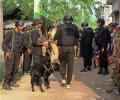
Prime Minister Narendra Modi's offer of central assistance in arresting the downward slide in West Bengal and National Security Advisor Ajit Doval's ongoing trip to the state and his asking for Mamata's cooperation in handling the situation and in dissolving the anti-national and inter-country network of jihad that has now chosen her state as one of its base, is perhaps Mamata's last best chance to salvage the situation, says Dr Anirban Ganguly.
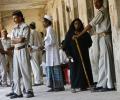
The BJP's panicky return to basic-instinct majoritarianism in Bihar has pushed Muslims back into the 'secular' basement, says Shekhar Gupta.
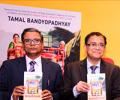
Kolkata's creme de la creme turned up at the launch of Bandhan, The Making of a Bank, but the evening nevertheless had an informal touch typical of the young bank with CMD Chandra Shekhar Ghosh personally welcoming the dignitaries, reports Indrani Roy/Rediff.com.

'Putting Yogi Adityanath in the CM's seat two years before the 2019 Lok Sabha polls is something to be read carefully.' 'Opposition parties would be dishonest themselves and unfair to secular people if they failed to unite and work as a single force to defeat the BJP.'

Accusing the Congress of putting its interests above the country's, Prime Minister Narendra Modi on Friday tore into the Oppposition, saying unlike earlier when opposition parties stalled Parliament against scams, Congress- led parties are now doing so against government's steps to curb black money and corruption.


'I am quite optimistic that sooner or later, my wishful thinking would turn into a reality.' The only hitch is that the INC president's own career ambitions may be hurt if the Congress merges with the BJP,' says Sudhir Bisht.
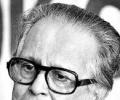
R K Laxman was suffering from a prolonged illness.
'We have got our permutations and combinations in place.' 'We are also trying to garner support from some NDA allies.' 'Every section of society has suffered during the four years of Modi rule.'
Sonia Gandhi's iftar was meant to be a powerful show of unity of Opposition parties to take on the Modi Sarkar, but that was not to be...

Given that public memory is short, we felt it was the right time to go back a little in history and test your memory about who said what and when about China with a little quiz. Enjoy!
'It will be our attempt that in order to get the country out of the condition it is in because of their (the BJP) coming to power, the Congress will go to them (leaders of parties opposed to the BJP) and if there is need for support we shall do so too.'
'There appears to be in the Indian polity a link between being Single and being of prime ministerial timber. It is a trend, a preponderance -- not a statistical verity,' says Dr Shashi K Pande.
.jpg)
BSE auto index surged 2%, capital goods, healthcare and oil & gas indices also up.
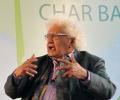
'For now, the AAP is the conversation,' Lord Meghnad Desai tells Rediff.com's Sanchari Bhattacharya. 'Everyone is talking about the 'Delhi model'. They have made so much difference. They have changed politics.'

Former RA&W chief A S Dulat, who served as Atalji's adviser on Kashmir, gives us an insider's glimpse of a prime minister he has hailed as the 'greatest after Nehru'.
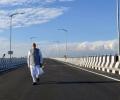
'I say Modi was India's last chance.' 'Because the kind of work this government has done -- I'm talking about physical delivery -- is fantastic, like no time in our history.'

'We have to find a way out of this confrontational politics.'
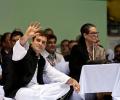
The resurgence that Congressmen feel is in fact more sentimental than substantive. The substantive reality is that the Congress is a party in terminal decline since 1989, says Shekhar Gupta.

In Tamil Nadu politics J Jayalalithaa is the queen of all she surveys today, But there are some ground realities that may still dent her high ambition. Rediff.com's Sheela Bhatt's fascinating new column where she reveals the ground realities in the Battle for India.
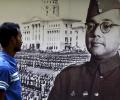
'The non-violent movement would not have brought freedom to the country, that had to be an armed struggle.'
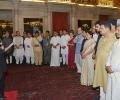
'The reason why Prime Minister Narendra Modi should have attended the President's iftar was not merely to break a fast with the faithful, but more importantly to broker an understanding with India's second largest set of citizens,' says Shehzad Poonawalla.

'The Opposition has no option but to make it an 'All versus One' fight to even think about winning.'

M Thambidurai, leader of the All India Anna Dravida Munetra Kazhagam in Parliament, was unanimously elected as Lok Sabha's deputy speaker on Wednesday, making him the first leader to occupy the post twice.
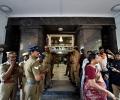
In private, AIADMK spokespersons say that the raid on Chief Secretary P Ramamohana Rao might be aimed at weakening the AIADMK, and demotivating the party from selecting/electing Jayalalithaa's confidante, Sasikala Natarajan, as her successor -- first as party head then possibly in the government, says N Sathiya Moorthy.

These homes offer services that help lead a smooth retired life.
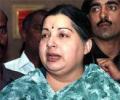
The presence of Sri Lankan President Mahinda Rajapaksa was not the only reason why Tamil Nadu Chief Minister J Jayalalithaa stayed away from Prime Minister Narendra Modi's swearing-in ceremony, says N Sathiya Moorthy.

'We felt why not have the hope that is intrinsic in every child's life, embodied in our happy protagonist and let viewers see the world full of double standards and confused adults around her through her innocent and questioning eyes?'

Anupam Kher on why he thinks the prime minister is a genuine person.

A summary of the day's play in the Ranji Trophy matches played across the country.

On Sunday, Prime Minister Narendra Modi expanded his Cabinet and inducted 21 new ministers. Of these, 4 - Manohar Parrikar, JP Nadda, Suresh Prabhu and Birender Singh were appointed as Cabinet ministers. Other than this, Modi has inducted 17 other ministers of state. Here's a quick look at them:
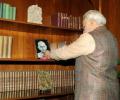
The prime minister is checking in with baggage of the kind that will make history, any which way things take a turn, says Sheela Bhatt/Rediff.com

Incidents of arson, firing and vandalism were reported from Madhya Pradesh, Rajasthan, Uttar Pradesh, Bihar and Punjab as protesters agitated against the dilution of the SC/ST Act.
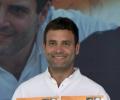
'The Congress is unsure of emerging as the single largest party or group on May 16. In such a scenario, they do not wish to accord a loser tag to the young Gandhi... The Congress feels Rahul's projection as a prime ministerial nominee in 2014 would come in the way of the formation of an alternative, non-BJP government...' Rediff.com's Sheela Bhatt explains how the transition of power within the Congress is making the party vulnerable.

What is the road ahead for Rahul Gandhi? Shehzad Poonawalla offers a blueprint.

Abstaining from voting on a UNHRC resolution on Sri Lanka was dictated as much by necessity and self-preservation as by a desire to place bilateralism at the front and centre of New Delhi's ties with Colombo, says Ramesh Ramachandran.

The 'secularists'are more adept at the politics of intense and alarmingly exaggerated fear-mongering, as this kind of politics provides easy votes of Muslims without making them answerable for the concrete issues of poverty, unemployment, lawlessness, and of basic needs like roads, electricity, etc, which is exactly how Nitish Kumar was defeated in the elections, says Mohammad Sajjad.

Atal Bihari Vajpayee would seek to placate the hawks in the RSS by stating that the writing of history should not be one-sided. At the same time, he would project a moderate 'Nehruvian' image of himself as the archetypal liberal politician who would strive to attain a balance between conflicting viewpoints. A fascinating profile of the former prime minister and Bharat Ratna by Paranjoy Guha Thakurta and Shankar Raghuraman.
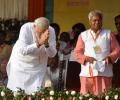
'There was an overt campaign and there was a covert campaign. The overt campaign may be development, government, and all this nonsense. But the covert campaign, which Mr Amit Shah was doing, was far more important with the help of RSS cadres. This has been an RSS election. From day one I have been saying, this is not Congress versus the BJP, this is Congress versus the RSS,' says Jairam Ramesh, one of the key strategists of the Congress party.
